
It is twenty past six and the house is still asleep. The kettle is on, the notebook is open, and you have written the date at the top of the page and then, out of habit, a sentence that sounds exactly like you: reasonable, fair, the kind of sentence you could read aloud to your sister without anyone getting upset. Then you stop, because you realise that you are writing for an audience again, even here, even at twenty past six in your own kitchen. Somewhere at the back of your mind there is a reader, a daughter clearing out the drawers one day, a partner who might glance at the page, a version of you who will reread it and wince, and you have been writing for them for years without noticing.
Most of the writing we do in a day is for someone else. Emails, forms, the message to the family group, the note to the school about the swimming kit. Even private journals are often secretly written for an imagined reader who will one day find them and understand us at last, so we arrange our sentences, we are fair to everyone, and we leave out the ugly bits. The strange result is that you can fill whole notebooks and still not know what you think. So I want to suggest a different kind of page, one that is truly nobody's business, and a single question to bring to it: what do I think when nobody is listening?
There is a long line of research on what is called expressive writing. In a well-known review, Pennebaker (1997) described studies in which people wrote about their deepest thoughts and feelings about a difficult experience for fifteen to twenty minutes on several consecutive days. Compared with people who wrote about neutral topics, those who wrote expressively often showed benefits in the months that followed, including fewer visits to health centres in some studies. Later research has found the effects to be real but often modest, and they vary from person to person, so this is not a cure for anything. Still, the basic finding has proved durable: for many people, putting a hard experience into private words seems to help (Pennebaker, 1997).
What is striking is how unglamorous the practice is. There is no special notebook, no gratitude prompt, no moon water, just a cheap pen, a timer and a few mornings in a row. And if you try it, you will probably find that the first page is rubbish. It is about the weather and the shopping. The second page is mostly complaint. It is somewhere on the third page, when the hand is finally tired of being polite, that a sentence slips out that you did not plan: I am so angry with her. I don't want to go. I miss who I was before. I am frightened about money. I think I made the right choice after all. Sometimes it is a surprise, and sometimes it is something you have known for years and never once let yourself write down.
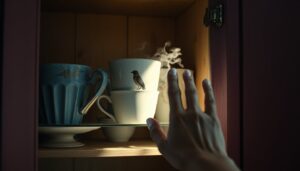
These pages do not have to be beautiful, and they do not have to be fair. They can contradict themselves, be furious on Monday and tender by Wednesday, and trail off in the middle of a sentence because the kettle has boiled. Nobody is marking them. Afterwards you can keep them, tear them up, or burn them in a safe dish on the windowsill while a candle burns beside it, and some people find the burning is the best part, because the words have done their work and do not need to be kept. What remains is a little more room inside, and very often one small clear sentence that you did not have when you sat down: the thing you actually think, the preference underneath all the explaining. That is worth fifteen minutes of messy handwriting before anyone else wakes up. And on Saturday we will take that preference somewhere even smaller, to the cupboard, and the cup you actually reach for.
Ritual Invitation
On three mornings this week, set a timer for fifteen minutes and write by hand about whatever is really on your mind, especially the parts you would not say aloud. Do not reread as you go and do not fix anything. When the timer ends, close the notebook, or tear out the pages and burn them safely in a heatproof dish beside a lit candle. Notice how you feel an hour later, and write down the one clear sentence, if one came.
Your Turn
What would you write if you knew for certain that no one would ever read it, and what did you find out you thought once the pen got tired of being polite?
Keep the Thread
Each week The Pulse brings one essay and ritual like this, free. Join The Pulse
References
Pennebaker, J. W. (1997). Writing about emotional experiences as a therapeutic process. Psychological Science, 8(3), 162–166. https://doi.org/10.1111/j.1467-9280.1997.tb00403.x
Keep reading