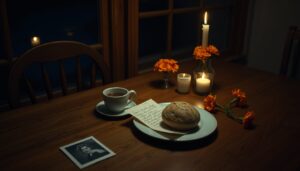

There is a song you used to love. You may not have heard it in years.
You did not decide to stop listening to it. It simply fell away, the way small things fall away when a life fills with other people. Someone in the car preferred the news. Someone at home thought it was too loud, or too sad, or just a bit much. The playlist became the family playlist, then the work playlist, then nothing at all because silence was easier than negotiating.
One day you hear it in a shop and stop dead in the aisle. You had forgotten that you loved it. You had forgotten that you were someone who loved things like that.
I think a great deal of the quiet disappearing that women describe happens this way. Not through any single large sacrifice, but through hundreds of small preferences gently set aside. The colour you would have chosen for the kitchen. The film you wanted to see. The way you like your eggs. The walk you would take if anyone asked. Each one surrendered for good reasons: to keep the peace, to save time, to be easy to live with.
None of them seems to matter on its own. Together, they are a person.
Part of what makes this hard to notice is that being alone with our own preferences can be surprisingly uncomfortable. In a series of studies, Wilson and colleagues (2014) asked people to sit alone in a room with nothing to do but think for between six and fifteen minutes. Many found it unpleasant. In one study, a notable number of participants, given the option, chose to give themselves a mild electric shock rather than simply sit with their thoughts, even though they had earlier said they would pay to avoid that same shock. The settings were artificial, and the findings do not mean people dislike themselves. But they suggest how strong the pull is towards doing something, anything, rather than meeting our own company with no task in hand. Wilson et al. (2014)
Preferences live in that unoccupied space. They need a little quiet to be heard. When every quiet moment is filled with reacting, scrolling, planning or helping, there is no room for the small voice that says: actually, I would like the window open. Actually, I would like the other one.
The return does not have to begin with large declarations. It can begin with the song.
Find it. Put it on. Not in the background while you do the dishes, though that is lovely too, but properly, once, with nothing else happening. Sit down, or stand in the kitchen, or lie on the floor if that is what the song wants. Let it be as loud or as sad or as much as it is.
You may feel silly. You may feel suddenly, inexplicably tearful. You may feel nothing much at all, and then later, while you are brushing your teeth, find yourself humming it.
All of these are signs that something has come back.
Then you might try another small one. The eggs the way you like them. The chair by the window instead of the one facing the room. The longer route home because it goes past the river. None of these needs to be explained to anyone. They are not demands. They are not rebellions. They are simply the shape of a person, being allowed to show again.
If someone asks why you are playing that old song, you can just say: I like it.
That sentence has more power than it seems.
Ritual Invitation
This week, find one song you used to love and have not heard for a long time. Play it once, properly, with nothing else happening: no phone, no chores. Notice what your body does. Afterwards, write down one other small preference you have let go of. Choose one to bring back before the week is out.
Your Turn
What song have you not let yourself hear in years?
Which small preference would you like to have again?
Keep the Thread
Signal, the third Witch in Progress book, is about exactly this: the small voice of what you want, and how to hear it again. Read Signal
Each week The Pulse brings one essay and one ritual like this to your inbox, free. Join The Pulse — free
References
Wilson, T. D., Reinhard, D. A., Westgate, E. C., Gilbert, D. T., Ellerbeck, N., Hahn, C., Brown, C. L., & Shaked, A. (2014). Just think: The challenges of the disengaged mind. Science, 345(6192), 75–77. https://doi.org/10.1126/science.1250830
Keep reading