May 15, 2026

Guardian Is a Form of Love

Guardian Is a Form of Love | Witch in Progress

There are beings who love by leaning in. There are beings who love by circling closer. And there are beings who love by taking up position.

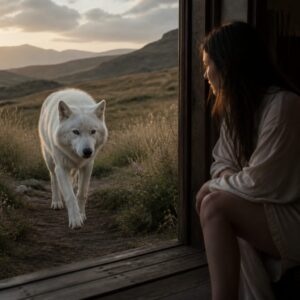
Luna is the third kind.

She sprawls in the exact place that allows her to monitor everyone at once. Not anxiously. Strategically. Ears in motion. Eyes attending. Body apparently at rest but never absent from the field. It is one of the things I adore most about her. She does not hover sentimentally. She keeps watch.

The claim here is that guardianship is not hardness. It is an organized form of love.

We tend to think of love in its soft expressions because softness is easier to market. Warmth. Cuddling. sweetness. Immediate comfort. But protective love has a different posture. It is oriented, not merely affectionate. It notices thresholds. It maps who is where. It tracks changes in sound. It speaks when needed and conserves energy when not. This is one reason guardian breeds are so compelling: their affection is inseparable from vigilance.

In human terms, we could call this co-regulatory presence. A calm, attentive being changes the felt environment simply by existing inside it with reliable awareness. Research on social baseline theory suggests that the presence of trusted others can reduce perceived load and alter how emotion and effort are managed (Beckes & Coan, 2022). A guardian animal can create a version of this too. Not by replacing human relationship, but by contributing to the field of safety and monitoring within a home.

And this is where Luna pierced me a little. Because I recognized that form of love immediately. The kind that does not need to chatter to prove itself. The kind that prefers to stay alert at the edge of things. The kind that can be quiet for long periods because its attention is already working. The kind that loves by noticing first.

I have often felt that my role with family is something like this. Not dramatic martyrdom. Not endless emotional service. Guardianhood. Noticing what is off. Seeing the pressure building before others do. Holding a perimeter. Using voice when necessary. Remaining quiet when unnecessary noise would only muddy the field. Luna makes that visible in animal form, and that visibility is both reassuring and slightly rude. It is unsettling to see your own nature walking around on four legs with better posture.

There is something old in this. Pre-modern households understood animals differently because survival made sentiment less stupid. A guardian was not merely beloved; a guardian mattered. Presence, warning, protection, territorial awareness, nighttime signaling — these were not cute traits. They were structural. The home was not just a shelter. It was a boundary to be maintained.

Modern people often forget that love and boundary belong together. Then they wonder why devotion feels so exhausted. A love with no perimeter becomes leakage. A perimeter with no love becomes control. The guardian solves this by embodying both. Protectiveness without constant aggression. Stillness without passivity. Voice without theatricality.

This is why Luna’s quiet matters to me as much as her bark. She is not noisy by default. She uses sound when it serves meaning. That kind of restraint is wisdom. It is also, frankly, more than can be said for many humans with internet access.

A guardian does not merely react. A guardian attends.

And to be loved by a creature like that is to be brought into a different kind of household order. One where safety is not assumed; it is maintained. One where attention has dignity. One where vigilance is not panic, but participation in the well-being of the whole.

Guardian is not a personality trait. It is a posture toward life.

And when it is rooted in love rather than fear, it becomes one of the most beautiful forms of devotion there is.

✨ Ritual Invitation

Tonight, choose one small perimeter in your life and tend it with love. Lock the door slowly. Light the lamp in one room. Put away one object that helps the house feel held. Let protection become visible.

💬 Your Turn

Name one way you love like a guardian instead of like a performer.
Finish this sentence: “The form of protection I trust most is __________.”

References

Beckes, L., & Coan, J. A. (2022). Social baseline theory: State of the science and new directions. Current Opinion in Psychology, 43, 221–226. https://doi.org/10.1016/j.copsyc.2021.06.004

Fine, A. H., & Beck, A. M. (2015). Understanding our kinship with animals: Input for health care professionals interested in the human-animal bond. In A. H. Fine (Ed.), Handbook on animal-assisted therapy (4th ed., pp. 3–10). Academic Press.

Payne, E., Bennett, P. C., & McGreevy, P. D. (2015). Current perspectives on attachment and bonding in the dog-human dyad. Psychology Research and Behavior Management, 8, 71–79. https://doi.org/10.2147/PRBM.S74972

Leave a Reply

linkedin facebook pinterest youtube rss twitter instagram facebook-blank rss-blank linkedin-blank pinterest youtube twitter instagram