
There is a window above my kitchen sink. Most kitchens seem to have one. Whoever first decided to put the window there understood something about the hours a person spends at a sink, and how long those hours can feel without somewhere to rest the eyes.
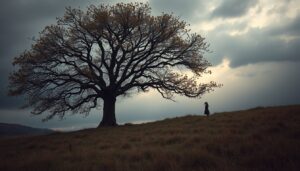
From mine I can see a fence, part of a neighbour's roof, and the top of a tree whose name I have never learned. It is not a view anyone would photograph. And yet I have watched that tree through every season of the last several years while my hands were in hot water. I have seen it bare and dripping, blossoming for about a week, heavy and green, turning, and bare again. It has kept me company through more evenings than most people have.
I did not think of it as a practice. It was just where my eyes went.
Then, on a particularly bad evening, I noticed that looking at it helped.
Nothing happened. A pigeon landed and left. The light changed slightly. My breathing, which had been high and quick, dropped down into my body a little without my asking it to. The plate in my hands became a plate again instead of one more thing to get through.
There is a well-known study that I think about at the sink. Ulrich (1984) examined the records of patients recovering from the same gallbladder surgery in one hospital. Some had rooms with windows facing a small stand of trees. Others had windows facing a brick wall. Those with the tree view had, on average, shorter postoperative stays, fewer negative comments in their nurses' notes, and took fewer doses of strong pain medication. It was a modest study in one setting, decades ago, and it cannot tell us exactly why. But it opened a long line of research into what green and living things in view might do for a person under strain. Ulrich (1984)
Later work has tried to look more closely. Bratman and colleagues (2015) found that people who took a ninety-minute walk in a natural setting reported less rumination afterwards, and showed reduced activity in a brain region linked to it, compared with people who walked in an urban setting. A walk is not a glance through a kitchen window. But both studies point in the same quiet direction: the living world in view may help loosen the grip of a mind that is going round and round. Bratman et al. (2015)
Most of us cannot take a ninety-minute walk in the woods on a Tuesday. Many of us can look up from the sink.
I have come to treat that window as a small steadying ritual. When the evening is crowded, I let my eyes go to the tree and stay there for the length of three plates. I do not try to think anything. I only notice what is there. The colour of the sky above the roof. Whether the leaves are moving. A bird, if one arrives. The first lit window in the house across the way.
The mind still wanders. It goes to tomorrow, to the conversation, to the bill. Then it comes back to the tree, which has not gone anywhere. That is the whole practice. The tree is steady, and for a few minutes I borrow some of it.
If your sink faces a wall, there are other windows. The one beside your bed. The one on the landing. The square of sky above a car park from your desk. A potted plant on the sill can do some of this work, too. What matters is less the grandeur of the view than the habit of letting your eyes rest on something alive.
The washing-up will be finished either way. The question is only whether you are there for it.
Ritual Invitation
Tonight, at the sink or any window, let your eyes rest on one living thing outside: a tree, a patch of sky, a bird, a plant on the sill. Stay with it for the length of three plates, or three slow breaths. When your mind wanders, let it come back to the living thing. Notice whether your shoulders change.
Your Turn
What do you see from the window you stand at most often?
What living thing has been keeping you company without your noticing?
Keep the Thread
For a ritual you can do in three minutes at any window, the free 3-Minute Reset is here whenever you need it. Take the 3-Minute Reset
The Return to Yourself course gathers small steadying practices like this into a six-module method for real, crowded lives. The presale is open. See the course
References
Bratman, G. N., Hamilton, J. P., Hahn, K. S., Daily, G. C., & Gross, J. J. (2015). Nature experience reduces rumination and subgenual prefrontal cortex activation. Proceedings of the National Academy of Sciences, 112(28), 8567–8572. https://doi.org/10.1073/pnas.1510459112
Ulrich, R. S. (1984). View through a window may influence recovery from surgery. Science, 224(4647), 420–421. https://doi.org/10.1126/science.6143402
Keep reading