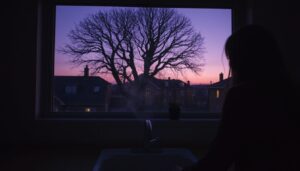

The last hour of the day has a strange reputation. It is supposed to be ours. The children are in bed, or grown. The work has been put away, or at least closed. The kitchen is mostly clean. This is the hour, we are told, for rest.
And yet for many of us it is the hour in which we finally do all the things there was no room for. The scrolling we postponed. The messages we did not answer. The worrying we were too busy to do properly earlier. We lie in the half-dark with a bright rectangle above our faces, watching the lives of strangers, and wonder why sleep feels so far away.
I am not writing this from above. I know that rectangle well. Some nights it is the only thing that feels like mine.
But I have started to treat the last hour differently, and I want to tell you why.
Light is not only something we see by. It is also information. The body uses it to know what time it is. There is a carefully designed study I return to when I think about this. Chang and colleagues (2015) asked adults to read for several hours before bed on either a light-emitting e-reader or a printed book, over several evenings each, in a controlled sleep laboratory. When they read on the e-reader, participants took longer to fall asleep, felt less sleepy in the evening, showed suppressed melatonin, had delayed circadian timing, and were less alert the next morning. The study involved a small number of young adults and long reading sessions, so it is not a verdict on every phone glanced at in bed. But it suggests that what lights our faces at night may be telling the body that the day is not over. Chang et al. (2015)
I find it helpful to think of the body as someone who needs to be told, gently and repeatedly, that it is evening now.
Our ancestors had the sun to do this for them. Then fire, then candles, then oil lamps, each one warm and low and dim compared with the light we live in now. Their evenings dimmed on their own. Ours stay bright until we decide otherwise.
So the ritual is mostly about deciding otherwise.
About an hour before I want to sleep, I turn off the overhead light and turn on one lamp. A low, warm one. I let the room become smaller and more amber. If I can manage it, the phone goes to charge somewhere I cannot reach from the bed. Then I do something with my hands. Folding the last of the laundry. Rubbing cream into my feet. Writing three lines in the notebook. Making a cup of something warm that is not caffeinated.
It is not glamorous. It is not even consistent. Some nights I fail completely and find myself at midnight watching a stranger renovate a farmhouse. But on the nights the lamp goes on, something in me recognizes the signal. My shoulders start to drop before I have even sat down.
That is what a ritual can do when it is repeated. It stops being an instruction you give yourself and becomes a door the body knows how to walk through.
The hour before sleep does not have to be productive, improving or beautiful. It only has to be dim enough, and slow enough, that the body can believe you when you say the day is done.
Ritual Invitation
Tonight, about an hour before bed, turn off the main light and turn on one small, warm lamp. Put the phone somewhere out of reach of the bed. Do one slow thing with your hands for five minutes: fold, rub cream into your feet, write three lines, hold a warm cup. Let that be the signal. Repeat it for a week and notice whether the body starts to recognize it.
Your Turn
What does your last hour usually look like?
What is one light you could turn off, and one you could turn on?
Keep the Thread
Steady, the second Witch in Progress book, is full of evening rituals like this, for a nervous system that has been carrying too much. Read Steady
Next week, as the nights lengthen towards Halloween and the old festival of Samhain, we turn to what we have been taught to fear about our own knowing. If you would like it to find you, The Pulse is free. Join The Pulse — free
References
Chang, A.-M., Aeschbach, D., Duffy, J. F., & Czeisler, C. A. (2015). Evening use of light-emitting eReaders negatively affects sleep, circadian timing, and next-morning alertness. Proceedings of the National Academy of Sciences, 112(4), 1232–1237. https://doi.org/10.1073/pnas.1418490112
Keep reading