Embrace Inner Peace & Reflection
Ready to connect with yourself on a deeper level? The 21-Day Mindfulness Card Deck by MojoExpressions is designed to inspire tranquility and self-awareness. Each card offers a unique moment of reflection through vivid imagery and poetic inspiration, guiding you to reconnect with the present moment.
The 21-Day Mindfulness Card Deck features:
In just three weeks, you’ll discover:
Stress can be debilitating. It clouds judgment, affects our decisions, and prevents us from being fully mindful. Research has consistently shown that under stress, our brains enter a heightened state of fight-or-flight, causing us to make poor choices. This stems from the release of cortisol, a hormone that limits our ability to think clearly, problem-solve, or stay present.
Psychologist Mihaly Csikszentmihalyi’s groundbreaking research on flow gives us a way to shift attention away from stress. His work reveals that when we become fully immersed in a creative task—whether through art, music, or writing—we enter a state of flow. In this state, time seems to fade, and we can intercept stress as our focus shifts entirely to the task at hand. This state of deep engagement not only improves mental well-being but also helps us break free from the stress cycle.
So, how do we stop stress before it takes over? One of the quickest and most effective methods is boxed breathing. Various cultures have known and practiced this for centuries. In Buddhism, it’s called Anapanasati. Pagans have long used rhythmic breathing in rituals, while many other spiritual and healing traditions across the globe emphasize the importance of breathwork. Boxed breathing works by grounding us in the present moment, slowing our heart rate, and triggering the parasympathetic nervous system to calm the body.
Our ancestors faced immediate dangers like predators, while today, stress arises from sources like the economy, politics, aging parents, illnesses, and caregiving. But our bodies can’t distinguish between these modern stressors and ancient threats. The result? Chronic stress that wears us down mentally and physically, and unlike in the past, we don’t have the natural release mechanisms.
You’re not alone in feeling this way. In recent months, we’ve seen major companies announce layoffs, economic uncertainties continue to ripple across industries, and political tensions rise both globally and locally. Many of us are navigating these challenges while caring for aging parents or facing personal health issues. The weight of these combined stresses can feel overwhelming, and they impact all of us in ways we sometimes don't even realize. As someone who cares for my sister, who has Rett syndrome, I can tell you firsthand that caregiving takes its toll. Studies show that caregivers, healthcare workers, social workers, police, and rescue workers face immense amounts of stress. A 2022 report found that over 60% of healthcare workers experience burnout, and programs are slowly being implemented to help. Yet, we have a long way to go.
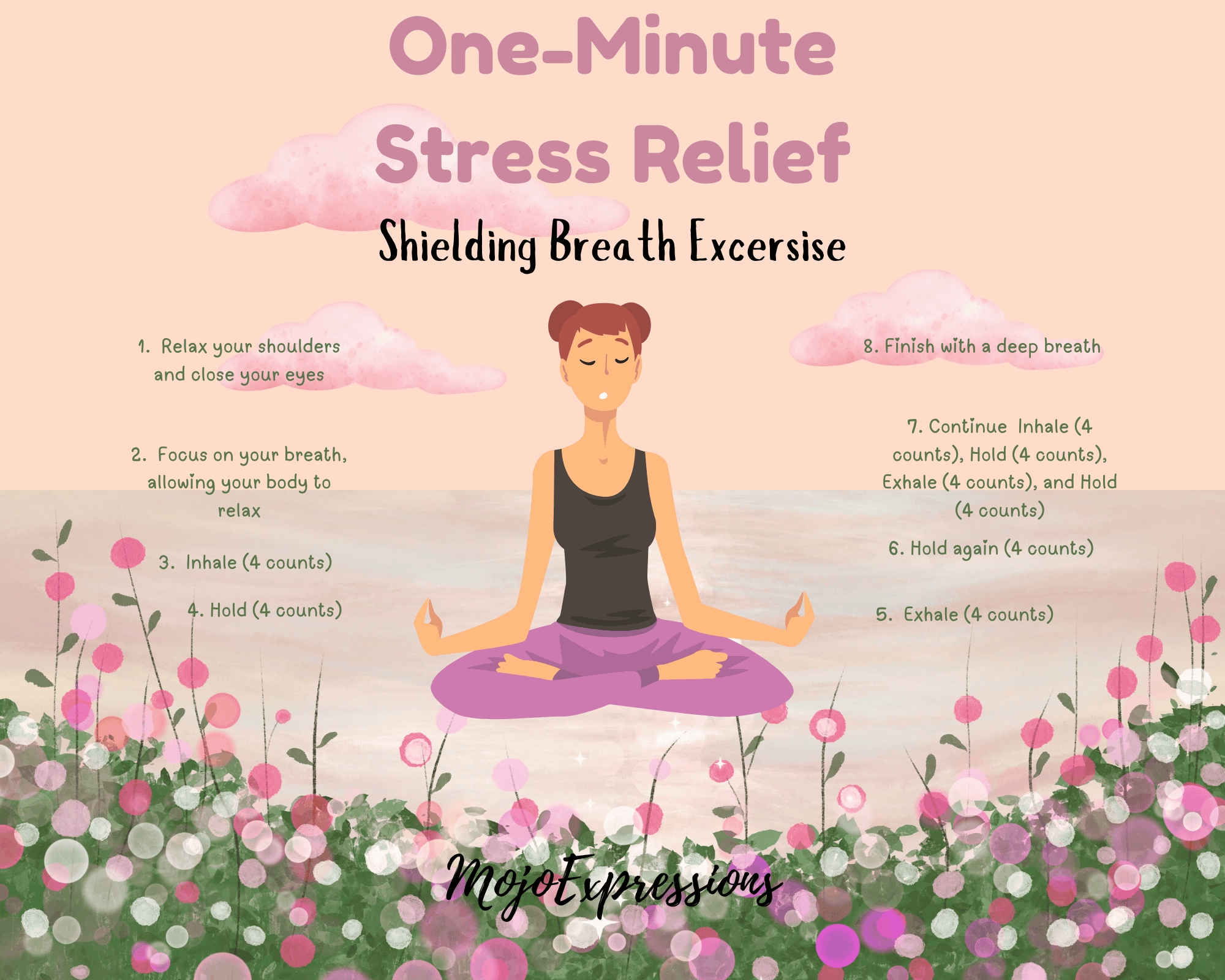
That’s why focusing on stress relief is vital, especially through mindfulness practices. Let’s take the first step toward a healthier mind. Here’s a one-minute stress relief poster—a visual guide to breathing exercises you can use at home or work. Print it out, put it on your wall, and make a habit of using it daily. This small act of mindfulness could be your first step toward relieving the burden of stress.
Join our community of like-minded individuals who practice mindfulness, share positive influence, and remind each other of stress-relief techniques. Together, we can build an engaging and supportive space where we all thrive. If this message resonates with you, please share it and the stress-relief poster with anyone who might benefit. Let’s help each other navigate life’s challenges.
One-Minute Stress Relief Digital Poster
A visual guide to boxed breathing—a simple, effective tool to help intercept stress in just 60 seconds.
Art and creative projects have long been celebrated for their ability to bring joy and inspiration, but did you know that engaging in these activities also triggers profound changes in the brain, influencing mental health, stress management, and overall well-being? In this article, we delve into the scientific studies and data that support the theory that actively participating in art and creativity is a powerful catalyst for positive change.
Numerous scientific studies have explored the impact of art on the brain, revealing fascinating insights into how creative activities influence neural pathways. According to research conducted by the National Institute of Health (NIH), engaging in artistic endeavors stimulates the release of dopamine, a neurotransmitter associated with pleasure and reward. This neurological response not only enhances mood but also contributes to stress reduction.
Mihaly Csikszentmihalyi, a renowned psychologist, introduced the concept of "flow" – a state of deep immersion and focus in an activity. Scientifically, this state is characterized by a specific pattern of brain waves. Csikszentmihalyi's research demonstrates that engaging in creative projects often induces this flow state, leading to heightened creativity, increased happiness, and improved mental well-being.
The concept of a growth mindset, popularized by psychologist Carol Dweck, emphasizes the belief that one's abilities and intelligence can be developed through dedication and hard work. Engaging in creative pursuits inherently promotes a growth mindset by encouraging individuals to embrace challenges, persist in the face of setbacks, and view effort as a path to mastery. Scientific evidence, including studies published in the Journal of Personality and Social Psychology, supports the positive impact of a growth mindset on mental resilience and well-being.
Scientific research on neuroplasticity, the brain's ability to reorganize and adapt, indicates that engaging in creative activities can contribute to positive structural changes in the brain. Studies, such as those published in the journal Frontiers in Human Neuroscience, highlight the potential for sustained positive changes in cognitive function, emotional regulation, and overall mental health through regular participation in artistic endeavors.
Artistic activities often induce a meditative state, promoting relaxation and stress reduction. Research from the American Journal of Public Health suggests that creative practices can lead to decreased cortisol levels, the hormone associated with stress. Moreover, engaging in mindful art-making has been linked to improvements in attention, focus, and overall emotional well-being.
The scientific evidence supporting the positive impact of art and creative projects on mental health, stress management, and overall well-being is compelling. As we embrace the neurological, psychological, and transformative benefits of creative engagement, it becomes clear that integrating art into our lives is not just a source of joy but a scientifically-backed pathway to positive change and enhanced mental resilience. So, pick up that paintbrush, explore your creativity, and let the science of art guide you towards a healthier and more fulfilling life.
Click on connect to join MojoCraft Collective!
Picture this: You, in your badass lair, paintbrush in hand, creating like a warrior poet. Artistic expression is your superpower, baby! Whether you're painting, doodling, or turning old junk into fabulous masterpieces, art is all about letting your soul run wild and free. The best part? When you're totally lost in the creative zone, you'll forget about your pesky boss, annoying ex, and all those toxic vibes. Who needs stress when you've got a canvas to conquer?
Art is not just about pretty pictures. It's therapy for your soul. Do you have some emotional baggage or trauma lurking around? Take those suckers, turn them into vibrant art, and say, "Bye-bye, emotional baggage!" Art lets you heal and grow, all while unleashing your inner diva.
Now, let's dive into the incredible journey of finding your individual style in art. Your artistic style isn't just about creating something unique; it's about telling the world, "This is me, and I'm here to shake things up!" So, here are a few tips to help you discover your signature style and let your creative flag fly high:
So, there you have it, fearless creator. Your individual art style is waiting to be uncovered. Let your artistic journey be a thrilling adventure filled with unexpected turns, wild inspiration, and a whole lot of you. Embrace the chaos, find your rhythm, and let your soul shine through your art like the magnificent masterpiece that it is. You're a creative force to be reckoned with!
Welcome my fellow soulful travelers of October! As the leaves don their vibrant autumn attire and the air carries a delightful chill, I feel a little more alive during this transformative season. Let's embark on a contemplative adventure together!
There is magic in October – a month that reminds us of the beauty of change. As I sip my rum tea (yes, I'm that person), I recognize that nothing remains the same, and that's okay. In fact, it's more than OK; it's awesome! Nature's transformation isn't a threat; it's a breathtaking symphony of colors and emotions.
Have you ever truly stopped to revel in the beauty of decay? It might sound a bit morbid, but it's like a somber yet vibrant celebration. The scent of fallen leaves, the crisp morning chill warming up to the gentle caress of the sun – it's an invitation to experience the world with all your senses and the duality of experience. Nature shows us that even in endings, there's exquisite beauty.
So, how can we connect more deeply with the world around us during this profound season of change? We can immerse ourselves in the outside world. We can pick up leaves, chestnuts, cones, and sticks, remaining in silence without judgment. We can look up at the sky, observing its ever-shifting hues without the need for words or explanations.
As we soak in the visual and sensory delights, we challenge our restless minds. Who is the one witnessing all of this? Does understanding or labeling change the experience? For a moment, let's release the need to perceive, analyze, or change, and just... be. It's a moment of profound connection – you and this moment are one.
Raising your mulled wine glass to October – a time to be a little more alive, to welcome transformation, to find beauty in the passing, and to connect with the world and our inner selves. Let's savor the season with a heart full of wonder and a mind at peace.
In order to make good decisions in your life and move towards goals you will need a reference point to start from.
All journey's begin and end with you. All you need is yourself.
But do not confuse your essential self with the thoughts that go on in your mind. You need to look past the flat thoughts as the primary indicator of your existence and allow yourself to identify with your multi-dimensional self holistically.
The fundamental truth is to think in reverse. "I am, therefore I think. "
The power of Being , once accessed, fuels the transformative process.
Your mind tries to find peace and fulfillment externally, because that is where you have been conditioned and taught to look. The mind will drive you crazy trying to find answers, planning, worrying, being angry, feeling lost. All the while you believe that these thoughts are "you". All that defines you.
But you are not your thoughts, you are the observer of the thoughts. Your feelings are states or instances, sort of posibilities of you but they are not you because when a thought or feeling is gone, you are still there, except you now have another thought or feeling. They do not control you and you are not defined by them. Nor are you defined by any other state of transition. By identifying with your created self and body, you are allowing yourself to go through rollercoaster ride and lack a strong foundation.
Creating change solely through mental techniques is impossible. Its only after you address the underlying energy holding thoughts that you start a transformation process. A Shift in energy is always followed by change in reality.
"All the world's a stage,
And all the men and women merely players;
They have their exits and their entrances,
And one man in his time plays many parts,
His acts being seven ages.".....
--William Shakespeare
Seeking For the Meaning of L
Are you the one who searches endlessly and looks for external answers or the one who looks within? Do you struggle with a sense of
This is how Sylvia Plath worded her experience on this quest:
“There are times when a feeling of expectancy comes to me, as if something is there, beneath the surface of my understanding, waiting for me to grasp it. It is the same tantalizing sensation when you almost remember a name, but don't quite reach it. I can feel it when I think of human beings, of the hints of evolution suggested by the removal of wisdom teeth, the narrowing of the jaw no longer needed to chew such roughage as it was accustomed to; the gradual disappearance of hair from the human body; the adjustment of the human eye to the fine print, the swift, colored motion of the twentieth century. The feeling comes, vague and nebulous, when I consider the prolonged adolesence of our species; the rites of birth, marriage and death; all the primitive, barbaric ceremonies streamlined to modern times. Almost, I think, the unreasoning, bestial purity was best. Oh, something is there, waiting for me. Perhaps someday the revelation will burst in upon me and I will see the other side of this monumental grotesque joke. And then I'll laugh. And then I'll know what life is.”
― Sylvia Plath, The Unabridged Journals of Sylvia Plath
You are never alone in the never-ending search for the way to make sense of life. All the ups and downs, the roller coaster ride that always seems to land us back to this familiar quest, at times when we lose hope or a clear sense of direction.
Ways to Interpret Life
There are those who believe in a "higher power", who serves as a guiding light through life's dark maze. There are those who take an existential nihilist point of view, with a belief that life has no intrinsic meaning or value with respect to the universe. Each individual, the entire human species is insignificant, without purpose or any universal meaning. That is a bummer...perhaps. I would not be surprised
Free Will
The good news as I see it, is that either way, we have free will. Even God, for those who possess the faith, presumes this and would presumably expect for us to act accordingly.
Instead of waiting for signs from the universe or some other external force, it is beneficial to put the effort forth to envision our place in this life, taking on some of the burden and responsibility as to shaping our path as our understanding of ourselves, our values and the world around us unfolds into our own consciousness. We cannot afford to ignore the laws of the universe, the knowledge passed on by those that pondered questions before us and gathered them into the many knowledge areas we now call science, philosophy, mathematics, and ethics. These truths can serve as milestones and road-signs along the highway of life as we learn to navigate traffic, terrain and road construction. We can take charge of shaping our lives, to the best of our ability, molding it into something of value to us and value to others.
I often approached my life quest exclusively from an academic point of view, assuming that the correct answer is already discovered and a method and process to achieve it should to be followed. The correct answer, being the correct life that fits me.
A "meaningful" life, however, is discovered as the means and not an end. It is not a known destination. It is a creative process. Instead of asking how to achieve a sense of purpose or meaning within life, perhaps we can begin by asking the following:
What, in the human experience could be the cause of sensing meaninglessness?
What to Consider as Meaningful?
The sense of disconnect and meaninglessness is the call to take a deeper look at what matters to you the most. The people we care about, the ideas and events that move us to action and the energy and effort we are able to channel into them, becomes our guide to where and how we need to be and a way to live. Those activities where energy feels abundant and time matters not, become the central focus.
Can you think of one such activity in your current life? Can you reflect on the meaning behind such activity?
Is it a sense of contribution to the people you love? Is it a sense of contribution to an idea or value you deeply connect with? Is it something that allows you to grow or connect with other people? Is it a medium of self expression?
“The restlessness and the longing, like the longing that is in the whistle of a faraway train. Except that the longing isn't really in the whistle—it is in you.”
― Meindert DeJong, The Little Cow and the Turtle
Identifying That, Which We Value
As we deliberate on each individual experience, we find meaning in the mindset hidden behind our actions.
Work diligently to incorporate more of that mindset into the daily goings and doings of your life. Rearrange your "to-do" lists to allow yourself time and space to express those values and bring about the circumstances where your energy can flow freely and easily. Remind yourself that this does not mean that you will not experience some sort of struggle, restlessness and conflict.
Wish to read more about mindset or as some people call it, virtues?
“Contrary to what we usually believe, moments like these, the best moments in our lives, are not the passive, receptive, relaxing times—although such experiences can also be enjoyable if we have worked hard to attain them. The best moments usually occur when a person’s body or mind is stretched to its limits in a voluntary effort to accomplish something difficult and worthwhile. Optimal experience is thus something that we make happen. For a child, it could be placing with trembling fingers the last block on a tower she has built, higher than any she has built so far; for a swimmer, it could be trying to beat his own record; for a violinist, mastering an intricate musical passage. For each person there are thousands of opportunities, challenges to expand ourselves.”
― Mihaly Csikszentmihalyi, Flow: The Psychology of Optimal Experience
Expect to move towards those moments where one's mind does not wander and time as perceived, is less important as it passes because one is "in the flow" of the experience.
“To overcome the anxieties and depressions of contemporary life, individuals must become independent of the social environment to the degree that they no longer respond exclusively in terms of its rewards and punishments. To achieve such autonomy, a person has to learn to provide rewards to herself. She has to develop the ability to find enjoyment and purpose regardless of external circumstances.”
― Mihaly Csikszentmihalyi, Flow: The Psychology of Optimal Experience
Create a "Habit" or call it a Ritual
When we experience such "flow", it can be beneficial to take a moment to recognize it, during and after the experience. We could "schedule" the activity and accept it as a practice or ritual.
Call it whatever seems most natural to you, with the exception of the following: "schedule" or "chore". Call it anything that will not make it sound like a requirement, which would deter from the natural preference for the activity.
“...It is when we act freely, for the sake of the action itself rather than for ulterior motives, that we learn to become more than what we were.”
― Mihaly Csikszentmihalyi, Flow: The Psychology of Optimal Experience
Create your Life - Choose the Meaning as Artists use Colors on a Canvas!
The canvas has an idiotic stare and mesmerizes some painters so much that they turn into idiots themselves.
--Vincent Van Gogh
Our lives begin as blank canvases. A child looks at the blank canvas and starts throwing colors on it. Each shape, image manifested from the beautiful imagination of the internal as they draw from the external reality of the world around them.
They go to school and they learn that there are external expectations, and soon external demands get center focus. Often the external world demands us to put curiosity, imagination and play aside, for the tangible goals of societal demands. Sometimes these demands will foster complacency and indifference.
If enough time passes between reflection on one's life, there may be a sense of disconnectedness. It is as if we no longer recognize the shapes and colors we made on our canvas. Justifiably so, because some of those shapes were manifested through our parents, teachers, bosses or they simply happened a while back, when we were so different from the person we know ourselves to be today.
Complacency is the root of meaninglessness
Perhaps we might be wishing the canvas was a whiteboard, so we could begin again as a childen. But for some of us, the idea of starting with a blank canvas induces a sense of dread enough, to want to swim back to the nice, lukewarm waters of complacency.
In order for your life to have meaning, its beneficial to sort through your values, move toward those actions mirroring your own principles, even if it is against the current norm. Do not worry about "what they will say".
Imagine all that would never have been accomplished, had individuals not had courage and strength enough to at least question the status quo and, at best, take action to move towards change. Your life is not a project that you can manage and measure monetarily or quantitatively.
One can reflect upon a perceived "good" life but one needs to experience it, in order to know that it is good.
Do not let complacency get in the way of creating your masterpiece!
Your life has too many dimensions, even in the tangible world including that vast expansion of "space", inside your mind, heart and to those who believe in it..the soul.
What other societal or personal causes do you perceive as a potential cause for the sense of meaninglessness?
What activities do you find fulfilling, where your energy flows and time stands still? What are your reasons for
Often in our society, we are defined by our individual achievements and accomplishments, schools we attend, work and career hierarchy, prestige, and monetary achievement. These things, however, can be unstable throughout life. What people around us recognize is often the things we base our self worth on.
Basing self-worth exclusively on such accompaniment can diminish our value, as it marginalizes the worth of those activities that have no monetary value, those we do outside of our work, activities that allow us to improve and grow, entertain others or those activities that allow us to contribute to communities and social groups.
Individualism is important in defining our unique, intimate character but we are part of the interdependent social web. Is it really a weakness that you need someone else's help? Is a child weak for wanting his/her parent's support?
We essentially owe our own development to the care and tenderness of others. Perhaps, owe gratitude to our families, teachers, coaches, psychologist, religious leaders and the entire economic-social system of a community for the effort they have contributed that leads to personal success in our lives.
No one can really survive on their own. People in a group can accomplish more than the sum of its' individuals. We cannot simply look to our own strengths in order to flourish. We need to allow others to help us, therefore we need to accept that we become dependent on their talents, knowledge, love or strength.
We can base our assumptions on the wrong knowledge. Our general knowledge of the good could be faulty therefore if we start out with something that is wrong, we can end up with the wrong choice.
Our knowledge of the particular circumstances could be wrong or our reasoning is faulty but we might still achieve the outcome desired.
We fail to deliberate at the right time or take too long.
Practical wisdom means we have the right intention, identify the right means and doing so at the right time. Practical wisdom deliberates from the "good life"
“Feeling lost, crazy and desperate belongs to a good life as much as optimism, certainty and reason.”
― Alain de Botton
-Immanuel Kant
Science is organized knowledge. Wisdom is organized life.
How do we achieve what is good?
There are no rules for applying knowledge to a given situation you are experiencing here and now. The "right reason" can vary from one occasion to another. Proving one view against another is not possible by argument alone. If you lack insight into what is good, I might not be able to convince you of the goodness of being kind. What is good or bad can also be interpreted differently in different cultures.
It is not possible to make generalizations about right or wrong, good vs. bad that would be true in all cases.
Even the ancient Greek philosophers agreed that rules and principles rarely apply clearly to real-life situations and moral knowledge can only be acquired through experience.
So if practical wisdom cannot be taught, how do you acquire it?
The path to practical wisdom starts with the right mindset or some might call it intention, others virtue. This refers to a valued quality of a human being. In the Greco-roman traditions, they prized four qualities, calling it the 4 cardinal virtues: temperance, prudence, courage, justice. In Christian traditions, there is humility, kindness, temperance, chastity, patience, charity and diligence. In Buddhism as outlined in the "Noble Eightfold Path" there is Right view, Right Mindfulness, Rich Concentration. In modern daily life, we might consider the right mindset or virtues to be any number of behaviors which are inherently beneficial to oneself and society. What appears good to someone depends on their character traits.
"Practical wisdom is the moral will to do what is right and the skill to figure out what the right thing is."
Because we are good we aim for a good life and we have a conception of what this involves. Pick any one or any number of the human qualities or traits we deem to be good.
If we go along with the presumption, that we can have good dispositions from birth, you can act according to your good nature but you still need to comprehend the nature of your actions. Without comprehension, you might be misled by others to be "good" for the wrong reasons or at the wrong time, which would not lead you to practical wisdom.
The right mindset has to be paired with reasoning and comprehension. We become good and practically wise as we gain more experiences in life.
Wisdom is not a product of schooling but of the lifelong attempt to acquire it.
-Albert Einstein
-Aristotle
“Practical wisdom is a true and reasoned state of capacity to act with regard to the things that are good or bad forman .”
While theoretical (scientific) reason aims at the truth to determine the things we cannot change, practical reasoning investigates what is in our ability to change and aims at making good choices. In order to make good choices, our reasoning must be correct and we must also have the right desires. Reasoning about what we can change is deliberation. Practical reason, therefore, is expressed in deliberation.
“Lord, grant me the strength to accept the things I cannot change, the courage to change the things I can, and the wisdom to know the difference.”
Practical wisdom involves the following:
According to Nicomachean ethics, a work created by Aristotle, the 3 approaches of knowledge includes:
“It is the mark of an educated mind to be able to entertain a thought without accepting it.”
― Aristotle
A group of people, comprised of individuals, who through their own transformation, perception(s) or beliefs, cause a change to be perceived by more than the individuals.
“The power of a bold idea uttered publicly in defiance of dominant opinion cannot be easily measured. Those special people who speak out in such a way as to shake up not only the self-assurance of their enemies but the complacency of their friends are precious catalysts for change.”
― Howard Zinn, You Can't Be Neutral on a Moving Train: A Personal History of Our Times
It is not the possession of truth , but the success which attends the seeking after it, that enriches the seeker and brings happiness to him.
max planck
The seeker is a curious inquisitive person who asks what, who, why and how. The person looks to understand a particular topic and is open to perceive the various connection(s), pattern(s), process(es), methods across various disciplines to arrive at their own perceptions and meaning regarding that topic.
If you would be a real seeker after truth, you must at least once in your life doubt, as far as possible, all things.
René Descartes
“In a world of sleepwalkers an awakened mind is a teacher and a catalyst for new awakenings, whether they want to be or not.”
― Bryant McGill, Simple Reminders: Inspiration for Living Your Best Life
A person who is a seeker as defined by the definition in the link below, who through his/her inquisitive nature will take their own theory, perception or hypothesis and take action or bring it to a practice of such where the impact of such action(s) has a perceivable course of positive change (success). With this wisdom, he/she and others are able to gain a perspective and understanding of the topic. Other people can add this wisdom to their collection of experience, choose to incorporate it into a conclusion of their own or use it to cultivate their own transformation.
“Ah, Catalyst, can it be that you do not see all the changes you have made? Some by your resignation and acceptance of circumstance, some by your wild struggles. You say that you hate change, but you *are* change.
The Fool in Fool's Fate”
― Robin Hobb