
Put a small child in front of a fire and something remarkable happens: they stop. The constant motion, the questions, the climbing on furniture, all of it goes still, and they sit there with their mouth slightly open, watching the flames lean and steady and lean again, for far longer than they would watch almost anything else. Put an adult in the same chair and, for the first few minutes at least, the phone comes out. And yet even the most restless of us, given a cold evening and a fire and nothing urgent, will eventually go quiet and stare into it, the way people have always stared at rain running down a window, clouds crossing a hill, waves coming in, or snow falling under a streetlight.
It is easy to call this zoning out, doing nothing, wasted time. Environmental psychologists have a lovelier name for what these things offer. Kaplan (1995) proposed that the kind of focused attention we use for work, which takes effort to direct and hold, gets depleted with use, and that certain natural settings help it recover, partly through what he called soft fascination: things that hold our attention gently and effortlessly, like clouds, sunsets or moving leaves, leaving room for the mind to rest and reflect. Attention restoration theory has been influential, and research testing it has produced mixed results in places, but the central idea rings true to anyone who has watched a fire after a long day (Kaplan, 199590001-2)).
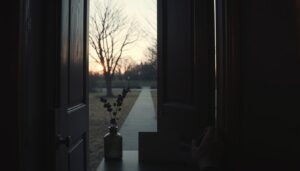
Soft fascination is the opposite of the hard fascination of a screen, which grabs and pulls and refreshes itself every few seconds so that you never quite land. It holds your attention the way a hand holds a bird, lightly, without squeezing. And the dark half of the year is full of it, if we look: the early dusk, candlelight on a kitchen table, frost forming on a windscreen, rain at the window on a Sunday afternoon, the fire if you are lucky enough to have one and a single candle if you are not.
The ritual is simply to let yourself watch. Not while doing something else, and not with the phone in your hand, but properly: the flame leaning and steadying, the raindrops joining and running, the clouds changing shape so slowly that you can only see it if you look away and look back. Your mind will wander, and that is part of it. Soft fascination leaves room for the mind to drift and sort through things, and to arrive at thoughts it could never reach by effort. You might find yourself remembering something, or understanding something, or just feeling the edges of the day soften, and then the flame catches your eye again and you come back.
Our ancestors sat around fires through long winters for warmth, light and safety, and it seems likely that the fire also gave their minds a place to rest after a day of hard attention, and gave the stories somewhere to start. We still have the fire, even if it's only one candle on the kitchen table. We still have the rain and the clouds. We only need to let ourselves watch, and on Saturday we'll go somewhere even warmer: the only room in the house with a lock.
Ritual Invitation
Once this week, light a candle or sit by a window where you can see rain, clouds or trees moving. Put your phone in another room and watch for ten minutes, doing nothing else. When your mind wanders, let it, and when the flame or the rain catches your eye again, come back. Notice how your mind feels afterwards.
Your Turn
What could you watch for hours as a child, and when did you last let yourself simply watch something move?
Keep the Thread
Each week The Pulse brings one essay and ritual like this, free. Join The Pulse
If this work brings you a little rest, you can help keep it going. Become a patron
References
Kaplan, S. (1995). The restorative benefits of nature: Toward an integrative framework. Journal of Environmental Psychology, 15(3), 169–182. https://doi.org/10.1016/0272-4944(95)90001-2
Keep reading